
An Interview with Manfred Lührs
“Electricity has always interested and fascinated me. If you generate it responsibly, you can do so much with it,” says Manfred Lührs. It was this enthusiasm that led to the establishment of 8.2 on October 2, 1995.
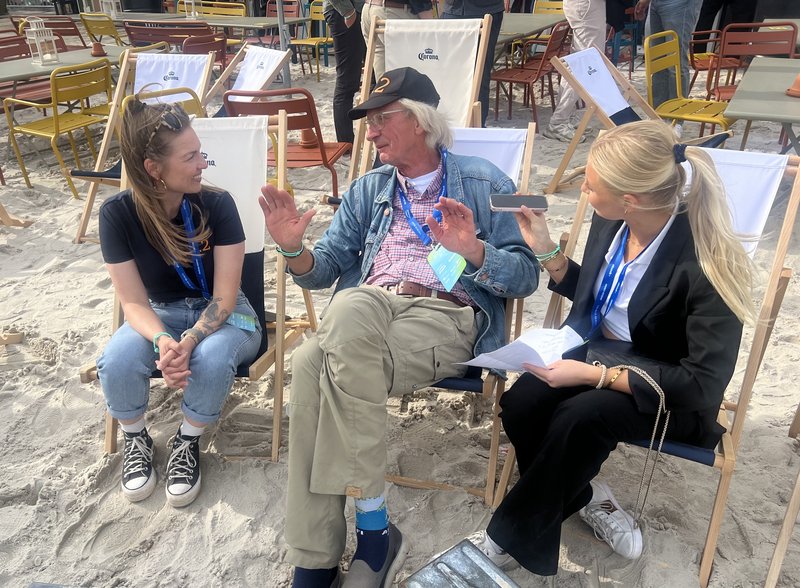
Manfred Lührs has been fascinated by the topic of energy since his youth. “I just find electricity so practical. You can do so much with it, but it must be generated responsibly,” he says in an interview. Driven by this conviction, on 2 October 1995 he founded the first 8.2 company, and with it the expert network that exists today — of which we are also a part. The company’s founder now looks back on a journey that has firmly linked renewable energy with independent consulting.
Manfred, to put it bluntly: Who are you, anyway?
M. Lührs:
I've always been interested in generating kilowatt-hours. It has always fascinated me. I took part in 'Jugend forscht' when I was 15, and ever since then, I've been wondering how electricity actually works. How is it generated?
Do you still remember your project for “Jugend forscht”?
M. Lührs:
Yes, of course I remember that! I built a scrolling light display, which later became commonplace. You can still see them in all kinds of shops today. Back then, I used neon tubes to make letters and numbers scroll by. It was actually my brother who came up with the idea. He’s 17 years older than me, but he wasn’t allowed to participate in “Jugend forscht” anymore. So his little brother, who was 15, had to step up. Then we spent the entire Christmas break working on it. The project wasn’t very successful – we had so little money that we had to build everything ourselves. For example, we wound the transformer ourselves. We were staying at City Hall. We had to go from the ground floor to the first floor, where the transformer core was, run the cable through it and up to the attic. Then we had to run the cable back down to the core and back down to the ground floor. We did that for three days. Just so we wouldn’t have to buy one.
Unfortunately, the transformer was not properly insulated because a pair of pliers had fallen into it, which caused the transformer to break. This caused the whole string of lights to stop working. That was my project for the 'Jugend forscht' competition. It was then that I first became interested in how kilowatt-hours are produced. Later on, I built my first windmills and car lights. Those were my early days.
What motivated you to start 8.2?
M. Lührs:
I had previously worked as a manufacturer at a small company. There, we built 30-kilowatt systems, and starting in 1990, I was the sales manager at what was then Germany’s largest equipment manufacturer. My employee number was 50 when I started there. And at one point, the company had 18,000 employees.
But I noticed that the manufacturers didn’t necessarily treat their customers well. 'Hiding what doesn’t work' – that’s what struck me at my own company. As the sales manager, I would sit with customers — usually farmers back then — and they would ask me, 'Why did you take down your system three kilometres away last week?' And I didn’t know. That’s not acceptable. That’s why I like to think of us at 8.2 as the “technical advocates for the operators”. I wanted to represent the operators more. To try to enforce their rights. My motivation was to help the customers.
Another motivation was that, in my role as a sales manager, I had often worked in the evenings. I often drove home late at night because customers usually only had time for meetings in the evening. However, I had started a family and wanted a more relaxed lifestyle. That’s why I decided to start my own business. But it didn’t work out. After six months, I was doing just as much as before. The company was founded on 2 October 1995, and in spring 1996, I secured a significant contract to inspect 17 systems on the island of Fehmarn. I spent three weeks working on that project. I did it all by myself, and when I had finished those 17 systems in three weeks, I told myself, 'You're never doing that again! What would I do if a job came in tomorrow with 50 systems?!' That's when I had the idea: 'I need a second office.' Ultimately, that's how the 8.2 Group came to be. Two years later, Jürgen Holzmüller — whom I knew from my former company — called me because he wanted to start his own business. That’s when I made the decisive suggestion: “Why don’t you start your own business under the name 8.2?”
That's how it worked, and it just kept going.
What does 8.2 stand for?
M. Lührs:
8.2 consists of many independent offices, ranging from 'one-person operations' to those with 40 employees. We work together on large projects and handle smaller tasks internally. This is what sets 8.2 apart from other conventional companies. They have a boss at the top of the hierarchy with inspectors below him. We’ve structured things so that many of the inspectors are their own bosses, too. This is part of our success.
And what exactly does “8.2” mean?
M. Lührs:
The original story is inspired by screw heads. With hex head screws, the strength rating is stamped on top. 8.8 is a common screw grade in wind energy, along with 10.9 and 12.9. These three are typically used. And that was the idea behind “8.” So, the reason it ended up being 8.2 is that eight and two are my favorite numbers.
Back then, choosing that name was risky because it was so unusual. I wasn’t sure if our biggest clients would accept it. Then the internet came along in 1996, and it turned out to be a brilliant choice. Names like that became commonplace online. It was easy to remember and type, and that’s how people found us. In hindsight, that was another major factor in our success. Whenever there are conferences — and there still are — we always show up right at the beginning.
What motivates you today?
M. Lührs:
In the past, the motivation was to generate kilowatt-hours. What has changed is this: When you drive through the countryside, you see power stations that have been shut down. That upsets me. We built those plants to generate power, not to shut them down.
Unfortunately, this has nothing to do with motivation. It's a real problem. The wind turbines aren't standing still because there's an expert working on them; they're standing still because we can't use the electricity they generate. We've had this problem for decades.
Wind and solar power are not available all day long. The only way to convert intermittent energy into a steady supply is through storage. While we can see that battery storage technology is on the rise, the systems being built are all far too small. We need long-term storage. We must be able to carry over the energy generated by solar panels from summer into winter. This can only be achieved through large-scale storage systems and hydrogen.
I've always wanted a team of male and female engineers, and I've achieved it!
Thank you so much for your interesting answers, Manfred!
M. Lührs:
You´re Welcome!
In order to prevent wind turbines from having to be shut down in future, battery storage systems are becoming increasingly important, as is the demand for certification in accordance with standards. Alongside the technical requirements for the systems themselves, the formal requirements for grid connection are also coming into sharper focus.
In this context, we handle the certification of battery storage systems and review the relevant system certificates and declarations of conformity required for safe and compliant operation. Would you like to request a no-obligation quote? Please click here.